Khaby Lame x Dakar 2026: TikTok's King Goes for Olympic Gold
Stop what you're doing because the internet's most-followed human just booked a ticket to the continent of his birth—and he's bringing 162 million TikTok followers with him.
Khaby Lame—the Senegalese-Italian factory-worker-turned-megastar who literally built an empire by silently side-eyeing absurd life hacks—has officially signed on as a countdown ambassador for the Dakar 2026 Youth Olympic Games. His quote, per olympics.com: "I can't wait." Two words. Five syllables. The man has made a career of saying less and meaning more, so this checks out.
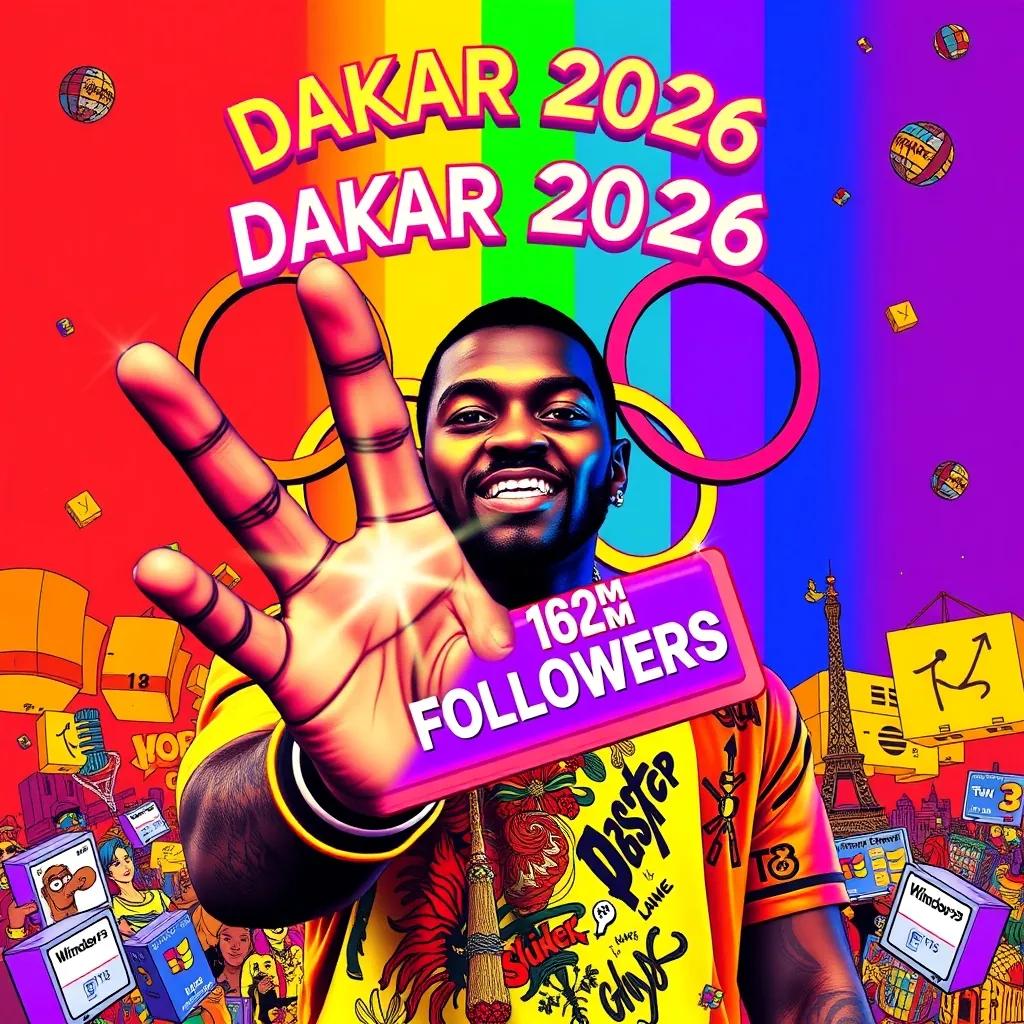
This is not your typical influencer-brand-deal plug. This is the first Olympic event ever held on African soil, and they just handed the promotional keys to a guy who communicates primarily through raised eyebrows and that signature hand-spread gesture. You know the one. It's been memed, merchandised, and studied by communication scholars. And now it's selling the Olympic dream to Gen Alpha.
The Numbers Don't Lie (Unlike Most Life Hacks)
Let's contextualize the absurdity of Khaby's reach. At 162+ million TikTok followers, he eclipses MrBeast (around 100M on TikTok, though Jimmy Donaldson obviously dwarfs everyone on YouTube with 300M+ subs), Charli D'Amelio (155M, the creator Khaby dethroned in June 2022), and literally every polished K-pop idol account. This is a man whose content budget is effectively zero—no production crews, no $3 million Squid Game recreations, no MrBeast-scale philanthropy stunts. Just him, his face, and the universal language of "are you serious right now."
The IOC didn't hire him by accident. Dakar 2026 is betting that a wordless comedian can crack the youth-engagement code that traditional Olympic broadcasting has been fumbling for a decade. Ratings for Tokyo 2020 and Paris 2024 skewed geriatric. Meanwhile, Khaby's audience is overwhelmingly under 25, global, and—critically—massively present across Africa, where TikTok penetration has exploded faster than Big Tech can moderate it.
Senegalese Pride, Italian Passport, Global Commodity
Here's the storyline that should have every talent agency in Los Angeles and Shanghai taking notes: Khaby Lame was born in Kébémer, Senegal, moved to Chivasso, Italy at age one, got laid off from a factory during COVID, and started posting duets mocking 5-Minute Crafts nonsense. Four years later, he's the face of an event happening in his homeland. That's not a brand deal—that's a cinematic arc.
The Dakar 2026 organizing committee understands something that Western sports marketers still struggle with: creator-led promotion doesn't just reach audiences—it belongs to them in a way that NBC primetime packages never will. When Khaby posts a countdown, his comments section lights up in Wolof, Italian, English, French, Arabic, Portuguese. That's not engagement metrics. That's soft power.
The Creator Economy Goes Institutional
This move signals a shift we've been tracking at ViralMVP for months. The era of creators being treated as disposable traffic-drivers for legacy institutions is ending. Khaby isn't just slapping his face on a poster—he's being positioned as cultural infrastructure. Compare this to how the NBA used Khaby courtside at All-Star Weekend, or how Hugo Boss made him a global ambassador in 2022 alongside Hailey Bieber and Kendall Jenner. The man has been building toward this.
Meanwhile, in China, we're watching a parallel play. Dong Yai's Cultural Travel (东方甄选) leveraged Dong Yuhui (董宇辉) from English-tutor-turned-livestream-poet into a geopolitical soft-power asset during the post-COVID consumption slump. Li Jiaqi (李佳琦), the Lipstick King, can move a billion RMB in a single Double 11 session. Xiao Yang Ge (疯狂小杨哥) has turned absurdist family comedy into a livestream commerce empire with 100M+ followers across Douyin. The East Buy (东方甄选) drama proved that creators aren't just personalities anymore—they're load-bearing pillars of entire business models.
Khaby's Olympic play is the Western equivalent of that institutional absorption. He's not endorsing the Games. He's becoming part of them.
What's Actually at Stake
Here's my opinionated take: this is either brilliant or the beginning of Khaby overextending into territory that dilutes his core magic. The reason Khaby works is simplicity. One setup. One face. One gesture. Done. When you start adding Olympic committees, press tours, and institutional expectations to that formula, you risk polishing away the raw authenticity that made him viral in the first place.
But I'm betting on Khaby. Here's why: he's demonstrated remarkable restraint so far. No corny Hollywood pivot. No embarrassing music career attempt (looking at you, Dixie D'Amelio and virtually every TikToker who's touched a microphone). No podcast where he rambles for three hours about things he doesn't understand. He's stayed in his lane, scaled carefully, and let the gesture do the talking.
Dakar 2026 runs from October 31 to November 13, 2026. Expect Khaby to be everywhere—on TikTok countdowns, in IOC content drops, possibly in some baffling crossover with Senegalese wrestling stars or African music royalty like Burna Boy or Tems. The full creator-economy playbook will be deployed: duets encouraged, sounds remixed, hashtags weaponized.
And somewhere in Chivasso, a former factory worker will raise his hands, spread his fingers, and communicate more about global youth aspiration than a thousand corporate focus groups ever could.
The Olympics finally figured out what TikTok knew all along: Khaby Lame doesn't need words to be heard.